The Product
Texas State University's Honors College promotes academic excellence. Texas State students and transfers with a 3.25 or higher GPA and Texas State applicants with qualifying test scores/class rank are eligible to apply for the Honors College. But the Honors College's mission is much more than just distinguishing students with good grades. The Texas State Honors College facilitates student scholarship: engaged, discussion-based learning through small seminar classes; resources that help Honors students pursue niche and interdisciplinary research or projects; enriching study abroad experiences; plus organizations which get Honors students involved in academic and local communities. In brief, the Honors College is a unique enclave of Texas State set aside for motivated students seeking a more rigorous education with a special character.
The Texas State Honors College uses a diverse set of channels to promote itself and keep various audiences informed about its offerings: emails, flyers, social media, on-campus events, and a website. While all channels are fully utilized for advertising current Honors opportunities, the website is the primary resource amongst these channels for accessing the application and the scheduling portal for Honors advising appointments, seeing a list of Honors courses being taught each term, viewing the requirements for maintaining Honors status and graduating in the Honors College, and performing other tasks related to Honors. The Honors website complements the other channels, which are temporal and oriented towards what's new and recent with Honors, by maintaining a persistent, logical, searchable, up-to-date interface for finding Honors information and resources. It provides a more custom-branded face for the Honors College than other channels, allowing the Honors College to express itself more creatively. It is the central place where prospective Honors student and their families find out whether they're a right fit for Honors at Texas State. The website is one of the handful of signals that tells a current or prospective Honors student, often subconsciously and indirectly, whether they belong in the Honors College.
As an Honors student myself, I wanted to fulfill the capstone project required for graduation in Honors by doing something that would meaningfully improve the Honors College, one of the communities to which I feel closest at Texas State, one which I believe enriches students' worldviews. I pivoted towards design as a professional focus shortly before I began this project and desired hands-on work with a user experience (UX) project rooted in some pre-existing facet of the real world. At the outset of my undertaking, with the guidance of my capstone advisor Grayson Lawrence who is a professor and UX designer himself, I did not have any specific goals in mind. My vague goal was to improve the Honors College by improving its website. How could I have any more specific intention at this point, without the context of what the Honors website's competitors were doing and input from the websites owners and users about their own experiences, pain points, preferences?
This case study documents the process of auditing the UX of the Honors website in order to provide evidence-based suggestions for the Honors College alongside the evolution of my goals into a specific, concrete form.
Product Competition
Note: For clarity, "Honors College" in title case refers to Texas State's Honors College. Other honors colleges are referred to as "honors college" without capitalization.Before I started my evaluation the Honors College website proper, I needed to explore the websites of similar honors colleges in order to gauge where the Honors College might be lacking in relation to a comparable honors college. Texas State University maintains a list of peer institutions who are "comparable in enrollment, student body, state funding, and mission" or whose statuses as research institutions are similar to Texas State's. Amongst these, I selected five peer institutions whose honors colleges had websites from which the Honors College might take inspiration:
- University of Houston
- University of New Mexico - Main Campus
- University of Arkansas
- Clemson University
- Arizona State University
Highlights from these honors colleges' websites are shown below. These highlights will be useful for ideation since their place on other honors college's published websites proves that they may be effective and that they are definitely feasible to implement.
Hero Sections
The hero section is the first view a user sees on a webpage. It is especially important on a homepage, which is often the user's first impression of the website and what it represents like, in this case, an honors college.
As shown below, there are ways the Honors website could make a better first impression than it currently does.
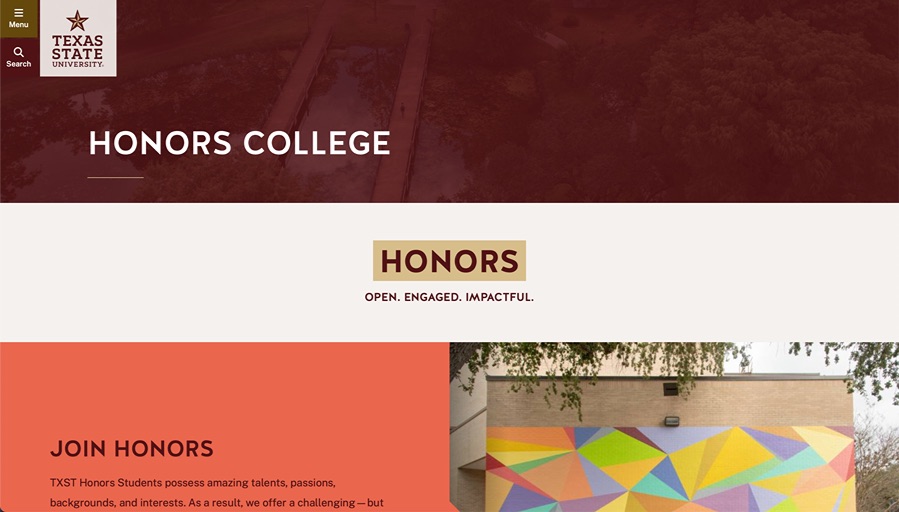
- The two banners at the top of the page take up most of a desktop screen, half of a mobile screen, and push informational content down and out of a user's initial view
- The solid colors with plain text do little to intrigue a first-time visitor about the Honors College
- The first text box targets prospective Honors students with an application and advising link but the copy is not descriptive or inspiring
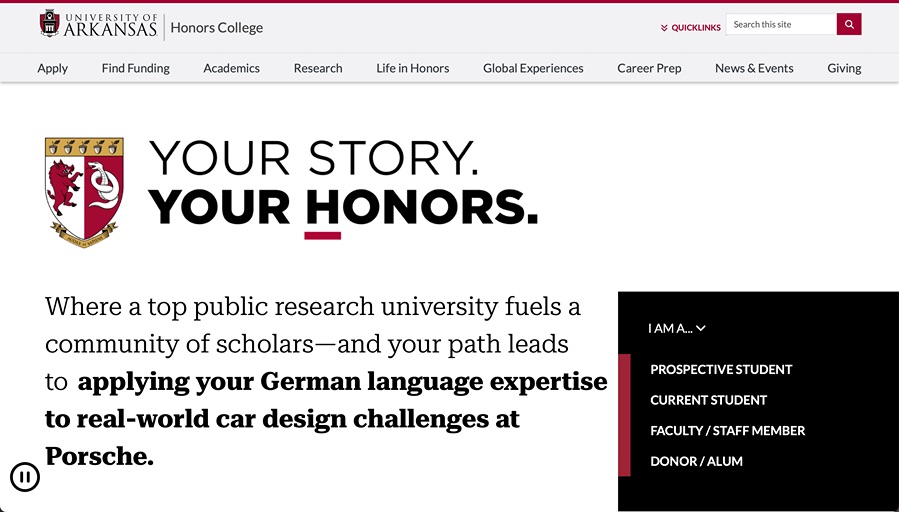
- The large, dynamic text splash engages the user as it runs a typing animation showing different examples of honors opportunities
- The clean frame of the hero inspires a similarly clean, organized, intentional impression of the honors college itself
- The menu in the bottom right helps the common audiences of the website access the content relevant to them faster
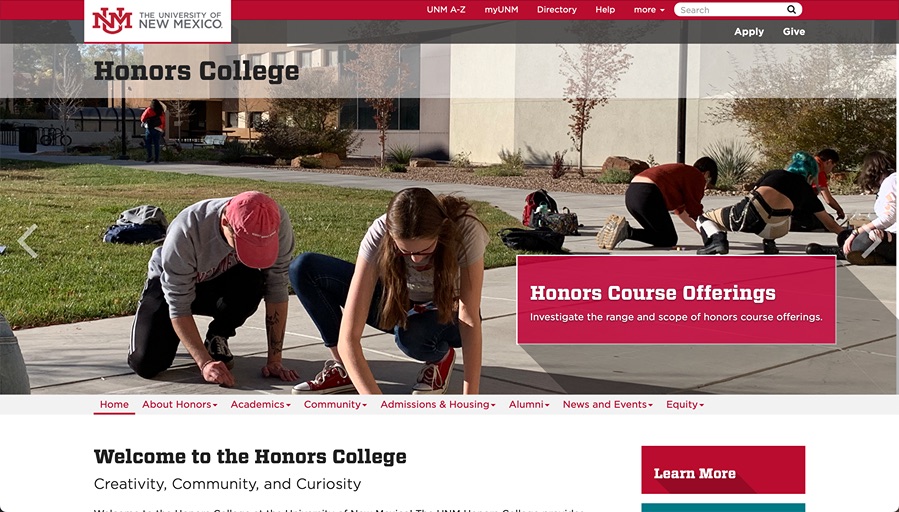
- A carousel automatically cycles images from real Honors activities that advertise and link to various Honors resources and opportunities
- Quicklinks "Apply" and "Give" in the top right highlight actions while neither disrupting nor blending into main navigation down below
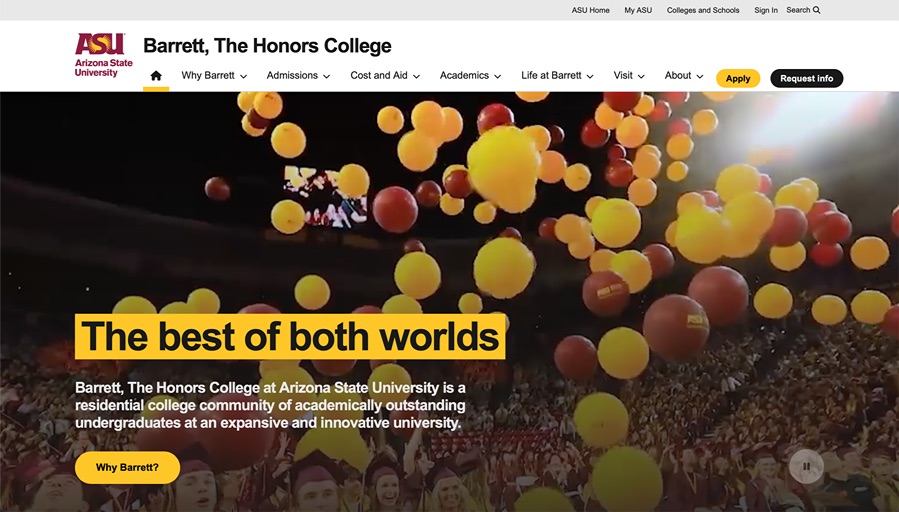
- A video fills the background and autoplays a montage with generic Arizona State footage; creates striking visual impression though does not depict honors college itself
- The emphatic copy immediately tells a user what honors college is and provides a link to further information about why they should join
- Quicklinks "Apply" and "Request info" are visually distinct to highlight action apart from main navigation beside them
Menus and Breadcrumbs
Menus and breadcrumbs are essential for navigating a website. Menus expose the information architecture (IA) of the website for better visibility over what a user can find on it and provide direct access to various pages. Breadcrumbs allow a user to see where their current page is within the IA of the website, providing a way to trace one's steps back to the homepage through the IA hierarchy of the site.
The Honors website's breadcrumbs are buried at the bottom of its pages and the menu is not responsive, meaning the compact mobile version appears on desktop too, restricting visibility.
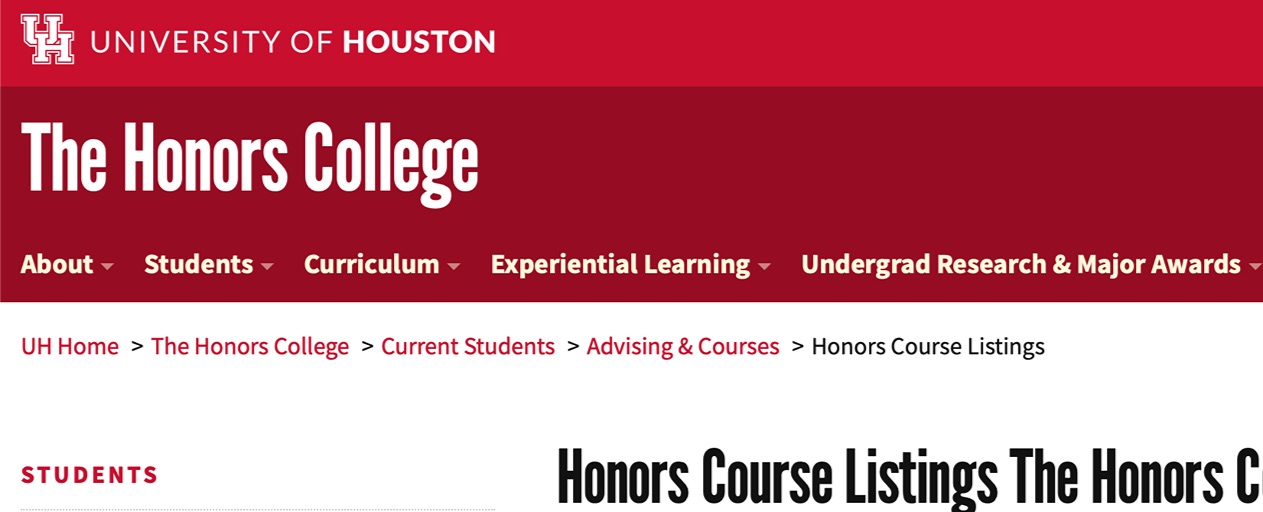
- Desktop menu example: "About", "Students", "Curriculum", etc. represents categories of the website; they dropdown into submenus when hovered and redirect to main page of that category when clicked
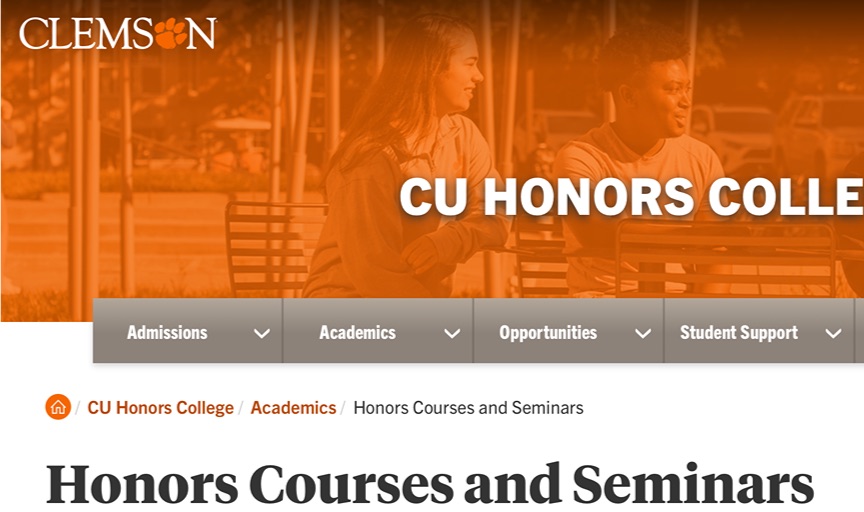
- Breadcrumb example: in this website's IA, "Honors Courses and Seminars" is under "Academics" which itself is under "CU Honors College," the honors website homepage.
In-Page Navigation
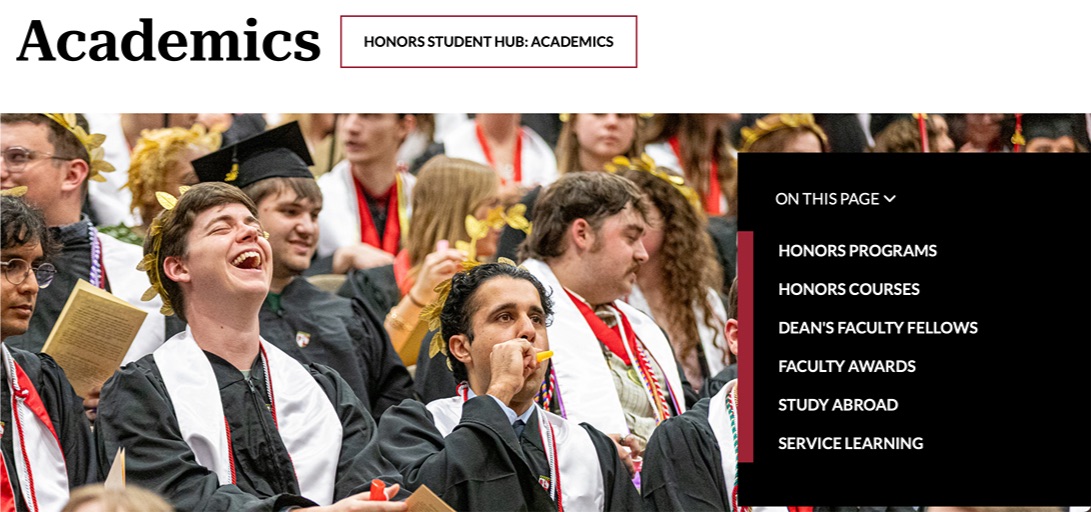
The University of Arkansas' honors college website packs more content into less pages, creating what's known as a "wide site." To allow users to navigate these longer pages quickly and without scrolling, the website incorporates in-page anchor link menus, alongside traditional sitewide navigation, that give the user options for jumping down the page to a section relevant to their needs. The benefit of this scheme is that information lives in fewer places and is less likely to get lost in the IA.
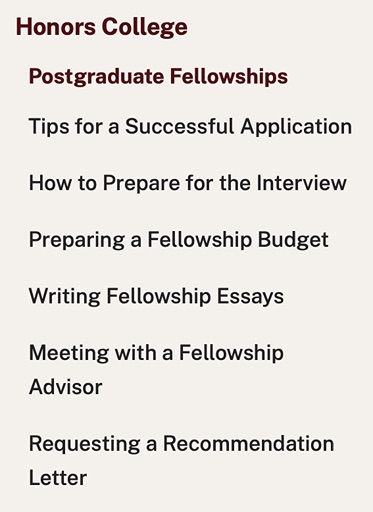
The Honors website could benefit from consolidating some information into single pages and using in-page navigation where the information is currently divided across many pages, like the postgraduate fellowship application guide currently split sevenfold.
Featured Students
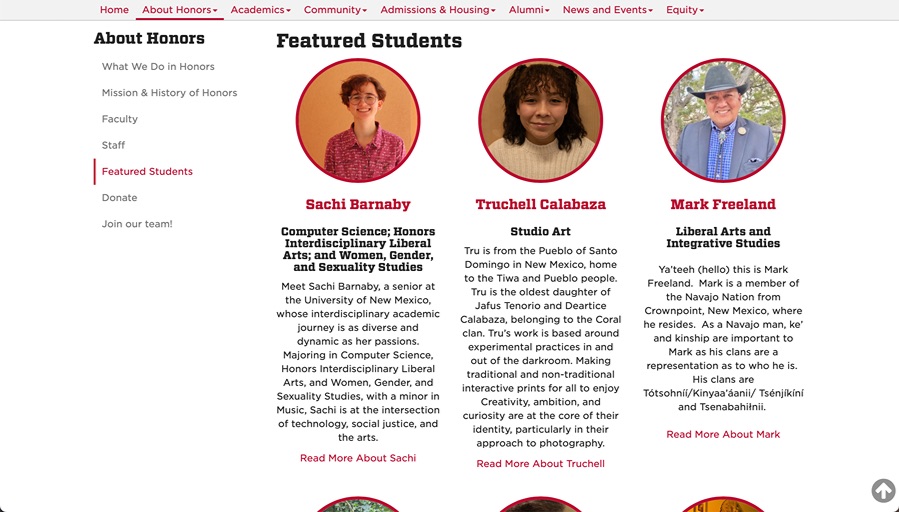
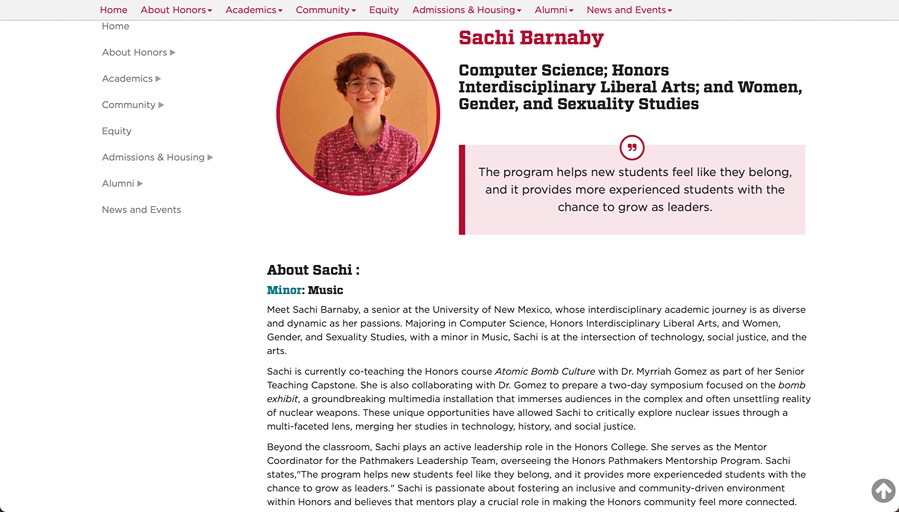
The University of New Mexico honors college website contains a unique page, "Featured Students." The page spotlights the biographies of real, current honors students in order to inspire other students and show them what's possible in the honors college.
Showcasing specific examples of Honors people and activities is one element which could help the Honors website act as a face for the Honors College.
Embedded Instagram
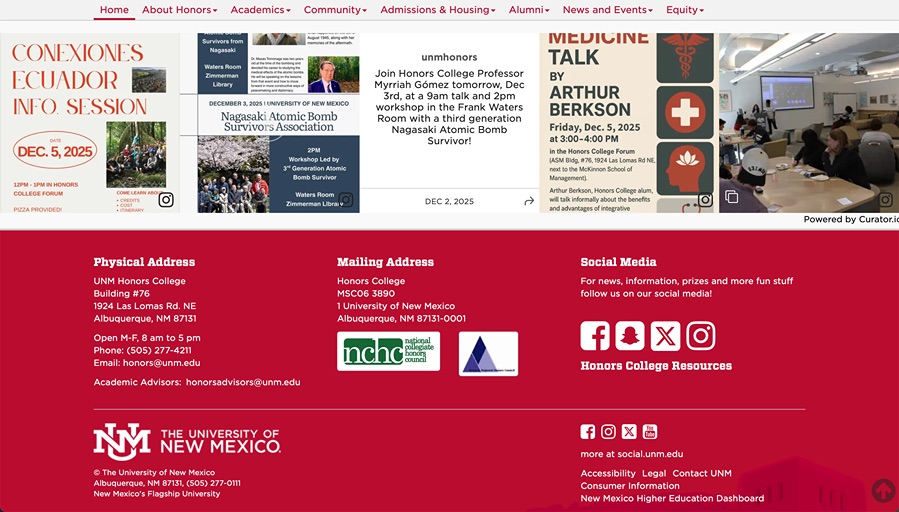
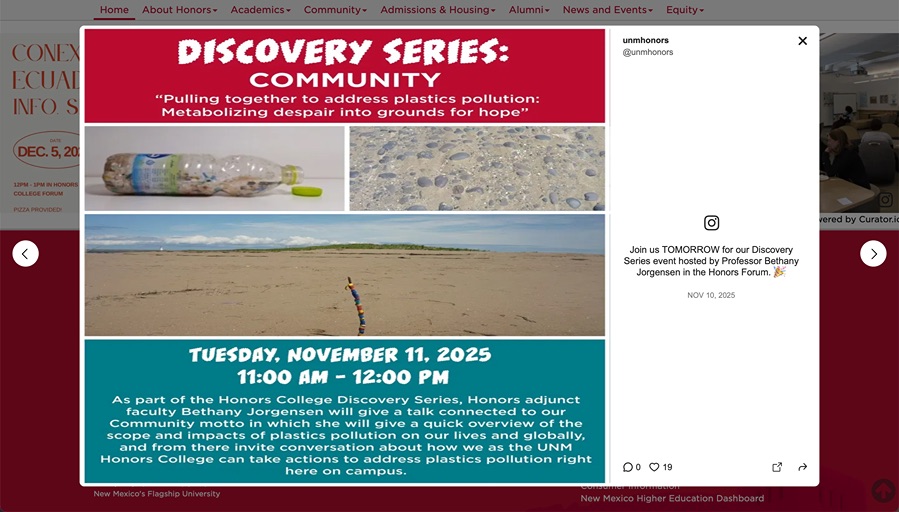
The University of New Mexico and Arizona State University both features embedded Instagram feeds on their honors college websites, allowing content posted on the Instagram to be visible from the website too, which is beneficial for reaching a wide audience even when part of it may not be on social media.
Since the Honors website homepage is not updated often, and staff bandwidth for editing the site is thin as mentioned below, an embedded feed of their most recent Instagram posts might allow the homepage to stay up-to-date without a manual workload besides the one-time setup.
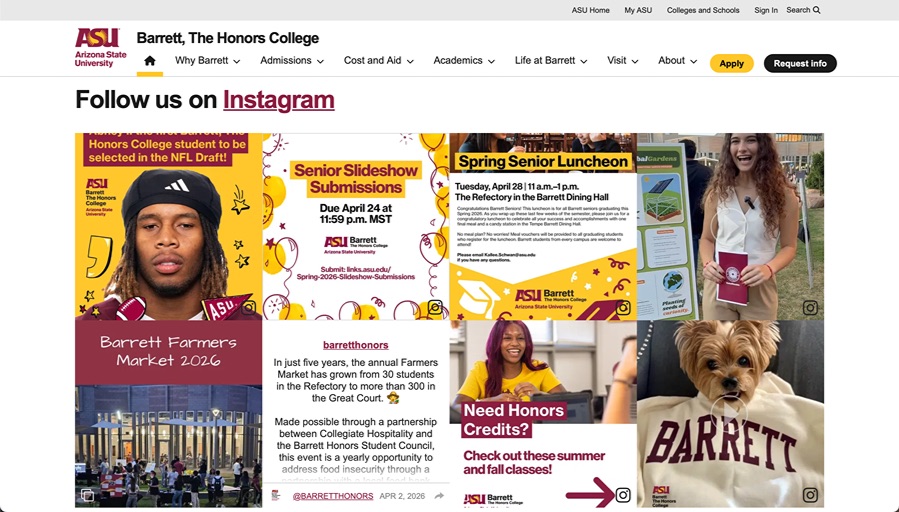
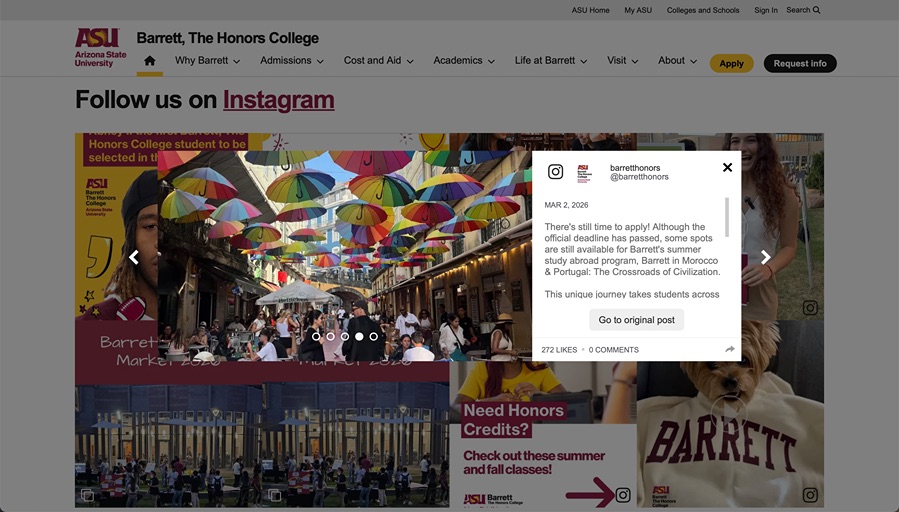
I kept these website features in mind as I synthesized pain points from owner and user feedback and ideated solutions for these pain points. My goal at this point was to consider these features as general usability improvements if they aligned with the needs I would discover through talking to product owners and conducting user research with Honors students.
Product Owners
This project was not undertaken with the Honors College's participation; that is, I would not be able to work alongside the Honors College in implementing the design changes I would suggest due to lack of interest and ability from the Honors staff to be involved given my timeline. In respect of this condition, I wanted to make my suggest changes feasible, something that could be implemented at little cost in time and effort. One measure of a design's feasibility is how much the product owners, who make decisions on the product being designed, might be interested in putting the design into production. Despite not working with the Honors College, I had the opportunity of getting some input on my project from the Honors Dean and Associate Dean before I began working with users.
Associate Dean
I received the Associate Honors Dean's input via email. Though his take was that modern websites are obsolete and students should search Google to directly find the information they're looking for regarding Honors, he did provide a few useful comments about the purpose and problems of the Honors website regardless:
- a repository for policy, capstone, independent study, course contracts, graduation requirements, etc.
- a source for information/publicity—events, activities
- provides background on the people and services Honors offers for those who don't know what the Honors College does
Roles of Website:
- recruitment/information for prospective Honors students
- information for current students
- information for other faculty/staff at Texas State
Goals of Website:
- The goals of the Honors website create substantial complexity since its audiences each have distinct needs
- The risk of the Honors website having multiple roles is information overload, and an expectation that the information is always fresh and updated (a substantial staff burden)
Problems of Website:
Dean
I met with the Honors Dean of in-person to discuss her view of the problems the Honors College faces. Besides systemic issues that lie beyond the control of the Honors College alone, she mentioned a handful of problems that the Honors College has faced consistently throughout her 20+ years as Dean:
- only a minority portion (less than a third) of the current Honors student population is actively enrolled in an Honors course during an average semester
- a non-trivial number of students never take an Honors class because they only applied to Honors for the early registration benefit (each semester, Honors students are able to register for classes before most other students)
General Problems:
- administration is small-scale and maintains little hard data to analyze trends in Honors student population, engagement, or website traffic
- students often ask questions to Honors faculty and staff, including the Dean, about information already on the website but the Dean suspects that what they really want is not clarification of content but an answer for one question the website's not answering, “Do I belong?”
Web-related Problems:
The input from the Dean and Associate Dean of the Honors college inspired a couple parameters for my ideation. The combination of the Associate Dean's apathy toward the website, the Dean's discussion of problems with low engagement, and the fact that both of them mentioned the small size of the Honors staff—all of this led me to prioritizing approaches that would reduce the manual workload required for website maintenance when deciding how to make improvements for engagement and other areas I'd determine through user research.
Another comment that particularly touched me was the Dean's instinct that students are asking not just for information but, more deeply, whether they belong. Because of this, I narrowed down my goal for this project: I wanted to focus on the student experience of the Honors website and somehow help inspire a sense of belonging by doing so. This helped me continue my project into user research since I now had a specific group to investigate.
Product Users
The heart of UX is in its name: users' experiences. I needed to research the current state of user experience on the Honors website in order to understand where and how I might improve it. Since I had chosen to focus on student experience in Honors, the users whose experiences I sought were Honors students. I investigated user's current experiences through a survey, interviews, and website analytics. In the survey and interviews, I focused on exploring Honors students' experiences and sense of belonging more broadly, in order to open up the possibilities of the website to serving students' larger needs, not only the problems they've encountered in using the existing website.
Survey
I conducted a survey in order to gather aggregate data on Honors students' experiences with belonging in the Honors College. The survey also included a few questions about their experiences with the Honors website. I ended up gathering 35 complete survey responses. In order to narrow data down to my target demographic, the survey only permitted respondents who clicked "Yes" on an initial question to indicate they were, had been, or will be an Honors student. A summary of results with implications for my project:
- The top three reasons respondents joined the Honors College were being able to register for classes early (11/35), taking Honors courses (11/35), graduating in the Honors College (4/35)
- Respondents' expectations when they joined the Honors College overwhelmingly involved an expectation of what Honors classes would be like compared to a typical college class: smaller, more rigorous, more interesting and unique, and more discussion-based with better professors and fellow students
- All respondents felt positively about their experiences with Honors, a majority feeling "Very Positive" (15/35); in a follow-up question, respondents cited impactful classes and professors, along with engaging events, as factors
- Only 11 checks indicated activity in Honors-affiliated organizations and opportunities (including Stelos Scholars, Phi Beta Kappa, Alpha Lambda Delta, and study abroad); this may imply less than 11 respondents, given the possibility of one respondent being active in multiple organizations or opportunities
Honors, What and Why:
These responses suggest that Honors courses are the center of the Honors experience, including the students and professors that one meets there. The website should do justice to these courses and capture why they're so central to the Honors experience.
- Respondents felt they "Mostly" (11/35) or "Somewhat" (9/35) belong in Honors; a follow-up question revealed that they don't feel they fully belong due worries about grades and whether they're perceived as smart, plus lack of involvement with Honors courses and events
- In a free response, respondents who felt they belonged commonly cited like-minded peers who care and engage with their learning and each other
Connection and Belonging:
These responses suggest a generic though important fact: engaging with one's peers fosters connection and belonging. The website should help facilitate peer connection for current Honors students and communicate to a prospective Honors student what their potential future peers are like.
- Respondents look for Honors information mainly through web search (16/35) or asking peers (15/35) and professors (13/35)
- Most respondents use the Honors website a few times a semester (14/35) or less than once a semester (7/35)
- The top Honors information that respondents look for on the website are Honors courses (20/35) and Honors requirements (17/35); a follow-up question revealed that finding information about courses and requirements is where participants have the most trouble on the website
Honors Website:
These responses suggest that Honors students mainly use the website around registration time each semester, when they're looking for courses that fulfill their requirements. This use case might explain why courses and requirements are the primary topic of pain points reported. The website should address these pain points and highlight this information so it's easier for students to find.
Overall, the results of the survey raise a few important foci for the website: Honors courses, Honors peer connection, and information about Honors courses requirements.
Interviews
I conducted interviews in order to investigate a few individual students' experiences in the Honors College in depth, so that I might better understand trends I saw in the survey results. I ended up conducting four interviews in total. A summary of comments with implications for my project:
- Most connected to Honors through its small classes where they get to know their classmates better and make friends
- Biggest impact of Honors on them is the opportunity to complete a capstone, which is the basis for their career
- Feels connected to parts of Honors relevant to their interests, not Honors as a whole
- First learned about Honors from friend in first semester, who mentioned early registration; exploring further information on website enticed them to apply
- Believes website fails to explain what Honors is, how it impacts students, and what opportunities it offers
Participant A:
Participant A's values agrees with the survey results: Honors students care about courses as a way to connect with their peers. They expressed their overall experience as coming from the curiosity to investigate Honors upon stumbling into it, however, and the website could better show off what Honors is about for students who aren't going to dig for information, according to them.
- Connected to Honors through its nostalgic, special atmosphere as a physical space
- Believes Honors gives students the opportunity to explore topics not typically discussed in the wider university setting
- What they've learned in Honors courses has changed their viewpoint on certain topics and inspired them to take action on issues they care about
- Interested in volunteering but unable to decide where and how to make time with studying; believes Honors could help students get into volunteering and that faculty can inspire students by getting involved themselves
Participant B:
Participant B craves not just new ideas, but new experiences; they want to do something about what they're learning, they want to volunteer. Lack of such hands-on opportunities in Honors is a wider problem than the website, but there might be opportunities not officially run by the Honors College which could be important to Honors students. Perhaps an Honors professor is leading a program not officially sponsored by Honors; can the website highlight these opportunities? Participant B has a connection to the physical space of the Honors College, something which the website could also better highlight.
- Culture of weekly Honors writing circle they attend provides a space where they feel free to be weird
- Events like bingo night do not help them meet people because the activities require too much attention
- Honors professors seem to treat them as human and want to hear what they have to say more than other professors
- Believes Honors attracts an eclectic community simply by being a niche space separate from the general university, rather than due to any inherent qualities of Honors
- Honors public speaking course made it easy for them to talk about their disability to other people
- Believes perceived difficulty of Honors is partially caused by lack of information on alternatives to traditional Honors courses
Participant C:
Participant C's value in the Honors community comes from its culture. While some of the culture they mention, like their writing circle, may not apply to the whole of the Honors College, the observation they gave on professors would be useful to showcase on the website, possibly using certain professors as examples. Their perceived comment (11f) aligns with survey result (8c); the website needs to better explain alternative sets of requirements for Honors students.
- Connected to people in Honors simply because it is smaller so people know each other more personally
- Enjoys that Honors has a more casual atmosphere, where they can talk with professors and students alike more easily; this makes it easier to work with them
- Positively impacted by Honors courses which expand their mind despite the more rigorous labor involved; benefits from other students being engaged in the work
- Believes contract course option to getting Honors credit should be more publicized
Participant D:
Participant D's sense of belonging in Honors comes from the knowing the people of the Honors community personally, something they attribute to how small and easygoing the community is. Like Participant C, they value the culture of the Honors community and add the fact that it benefits their academics, which would be a good point to advertise on the website. Comment (12d) falls in line with survey result (8c), demonstrating a need for the website to better communicate Honors requirements.
Overall, the interviews highlight the importance of connection in the Honors experience. Interviewees cited groups, professors, and peers within Honors as a major positive components of their Honors experience. It seems from these interviews that the Honors community's small size facilitates that connection, something worth better highlighting on the website. The interviews also support the survey results in suggesting that courses are central to the Honors experience.
Website Analytics
The Honors website had minimal analytics when I started this project, so I set up Google Analytics reporting on the website in April 2026. Based on data collected from then until October 2026, I've noted two useful insights about traffic on the Honors website:
- The majority of visitors come from desktop, 74.9% of active users; mobile users are 24.7% of active users and tablet users, the remaining slim 0.4%
- The most viewed page on the website is the Honors course catalog followed by the homepage and the page featuring admissions information and a link for the application
Given the fact that the Honors website is mostly accessed as a desktop website, revealed by (13a), it is pertinent to ensure that the website's mobile-first layout does not hinder the desktop version too much. One way in which this is present on the current website is how the desktop version's spacing may be too generous to a fault, pushing information offscreen as seen in the homepage hero section.
The page traffic data from (13b) aligns with survey result (8c), where a majority of respondents reported that the top information they look for on the Honors website is Honors courses. The data also reveals that a main function of the website is as a portal for the Honors application, since the page prefacing the application is the third most visited.
A few different sources of user insight contribute greatly to setting specific priorities in service of my broader goal, improving student experience and promoting sense of belonging. In summary:
- The survey results indicate that the website could better serve students in finding courses and requirements for Honors
- The interview results indicate that the Honors community promotes sense of belonging through its culture and small size, allowing Honors students to meet each other with greater ease, especially in courses
- The website analytics imply that applying to Honors is one of the website's most common functions
- The survey and interview results and website analytics all indicate that courses are a central part of Honors
Synthesizing these results, I narrowed my goal to a few specific domains which I've determined the Honors website should be positioned to highlight:
- Courses
- Requirements
- Applying
- Community
The first three are existing resources on the website which could be brought out more; the last domain implicates pulling content from outside the Honors website or else creating that content in order to showcase the people of Honors.
In addition to these domains, the input of the Dean and Associate Dean as well as data point (13a) set some parameters in my designs as I address these priorities: changes would need to be easy to implement and maintainable for Honors staff while supporting mobile and desktop experiences equally.
To be continued...
Product Ideas
Texas State University websites are managed by a content management system (CMS) which allow pages to be edited by non-technical admins using a toolbox of pre-built widgets and a simple menu of settings. The CMS ensures that Texas State websites follow the university's brand guidelines and web best practices given the framework that its editor enforces. A CMS is helpful for the Honors College since it allows their website to use a dynamic design out of the box with pages constructed fast using little technical knowledge on the site of the Honors staff creating and updating the website. The CMS is also helpful for how I implement ideas, since its constraints outline a design system within which I can narrow down possibilities to those that are feasible in the CMS. Given the evidence laid out in the previous sections, I determined a list of priorities for the areas that my redesign should improve on the Honors website:
In keeping with the input from the Honors Dean and Associate Dean, the changes I made to support these domains would better support Honors staff by being easy to implement and low maintenance.
While I originally planned to utilize a traditional prototyping toolset, starting with paper prototypes and then moving into Figma as my ideas solidified in a certain direction, I discovered an option that suited the nature of my project better. I realized I could download and edit the Honors website locally, copying CMS components from the HTML in order to add new content within the framework of the CMS. This saved me time from rebuilding the website on paper or in Figma when I only needed to alter a few pages or elements at a time; one important aspect of this approach is that the prototypes pass visually for the real website. While a visually convincing prototype adds the benefit of realism for users testing it, my advisor brought up the fact that such realism sometimes makes people avoid criticism of the prototype since it feels more complete and harder to change. In order to circumvent this aspect, I devised a preface to give before I conducted user tests: I would inform the user about how the website is edited with a CMS and that the changes they'll be seeing are minor tweaks being proposed by the Honors College. (add to below section, about getting honest responses)
    here:
      - What informed each design?
      - What did I learn from testing each design?

    Hero Section:
    Menu and Breadcrumbs: CMS constraint
    In-Page Navigation:
    Featured Students:
    Embedded Instagram:
User Test Design
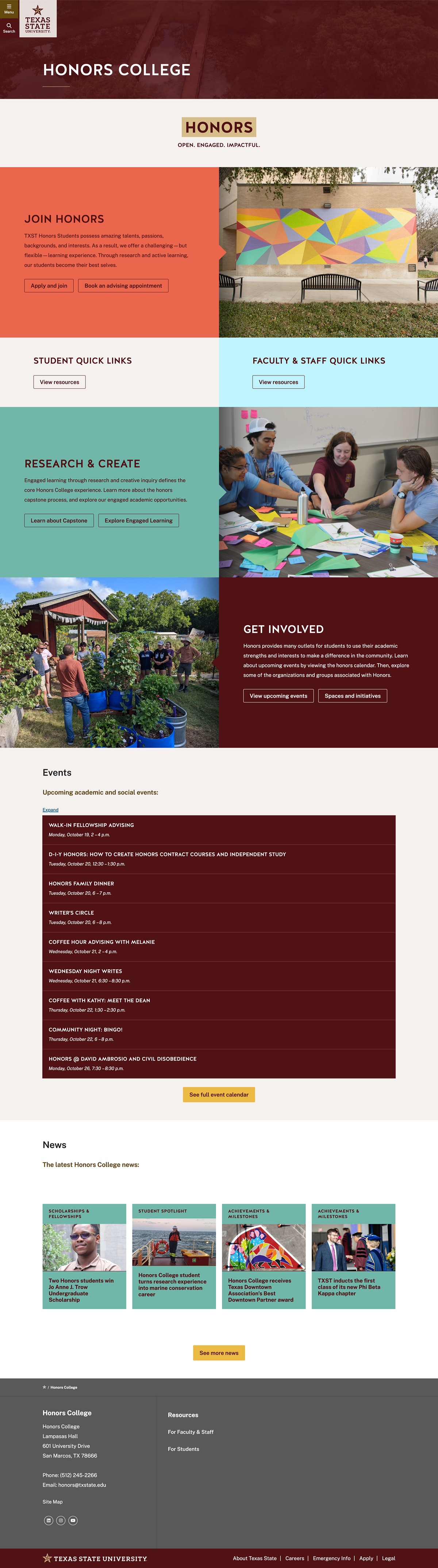
Original Design

User Testing
Design #1
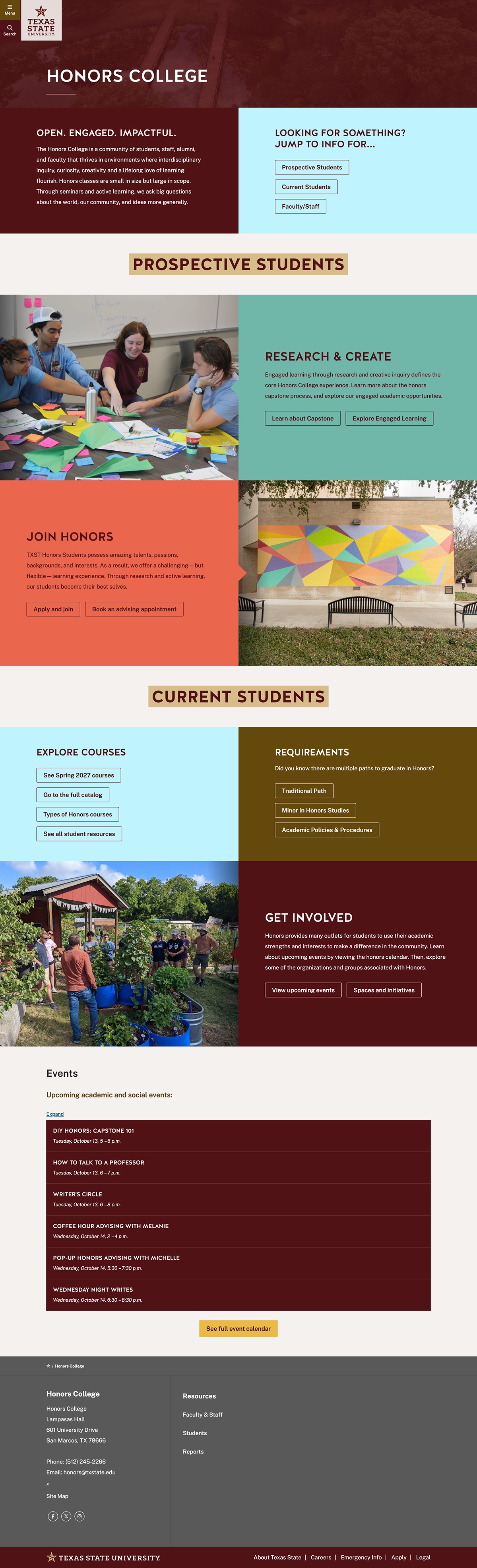

- Text in hero section explains what the Honors College is
- Anchor links in hero section allow current and prospective students to jump to sections tailored toward them
- Flow rearranged with section headers and an order that prioritizes START HERE
Design #2
User Testing
Design #3
User Testing
Final Product Suggestions
I thank Grayson Lawrence
    here:
      - How did my goals change throughout the project?
      - How well did I meet each goal?
      - From the synthesis of these goals, what do my designs achieve?
      - What aspects of my designs should be implemented?